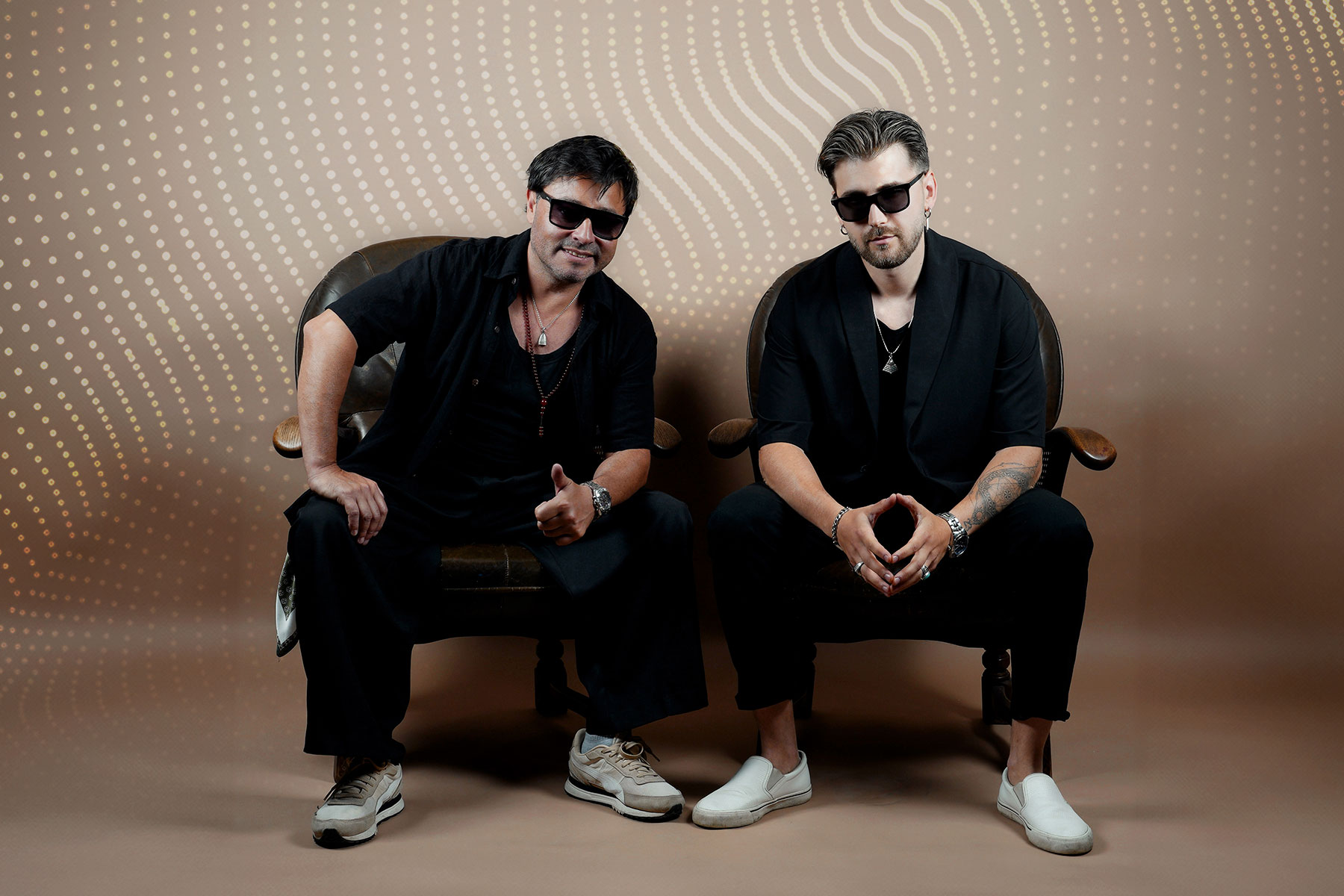
Christian Montoya & Alex Grosu arrive at this collaboration from different musical backgrounds united by a shared creative philosophy.
Photo credit: Christian Montoya / Alex Grosu – Official
The Chilean producer has spent more than two decades building an international career across Europe and beyond, while Romanian-born, Málaga-based multi-instrumentalist Alex Grosu has established himself as a saxophonist, guitarist, vocalist, and live performer throughout Spain’s Costa del Sol.
Together, they bring electronic production and live instrumentation into a project shaped by trust, shared instincts, and a commitment to emotional honesty. Their collaboration places organic expression at the center, combining Montoya’s club-focused vision with Grosu’s voice, saxophone, and performance experience.
In this conversation, Christian Montoya and Alex Grosu discuss creativity, longevity, collaboration, artificial intelligence, and the values they believe electronic music should continue to protect.
EG: Hi Christian and Alex. Where are you both today, and what kind of moment are you experiencing as this music prepares to reach listeners?
Christian Montoya: Hi! I’m currently based in Madeira, a truly wonderful island where I’ve been settled for some time now. I actually live in Funchal, and it has a very special place in my heart because it reminds me so much of my birthplace, Valparaíso, where I spent my early years. The energy and the hills are quite similar, so it really feels like home.
But I’m always on the move, traveling back and forth to balance my DJ residencies between Madeira and the Costa del Sol.
As for this moment, it’s super exciting. We’ve already tested the track with some great artists and close friends in the crowd, and the feedback has been absolutely amazing. We are just really eager to finally share it with the whole world. There’s nothing quite like that feeling of knowing the music is ready to reach the global dancefloor!
Alex Grosu: I am currently living in Málaga, Spain, which has been my home for more than 20 years, although I am originally from Romania.
At this stage of my life, I feel very happy, inspired, and creatively fulfilled. I am especially grateful for my work, as I perform throughout the Costa del Sol as a saxophonist, bringing live music to a wide variety of events and venues.
EG: Christian, reaching a significant birthday can change the way we measure success, time, and happiness. As you approach 50, what has become more important to you, and what have you finally learned to let go of?
Christian Montoya: Oh yes! Approaching 50 is definitely a moment for reflection, but I see it more as a celebration of experience than just a number.
What has become truly important to me now is the quality of things over quantity. After more than 20 years in this industry, I deeply value genuine connections: the real energy on the dancefloor, the creative freedom to make music that I truly feel, and the beautiful balance I’ve found living between Funchal and the Costa del Sol.
As for what I’ve learned to let go of… definitely the ego and the need to chase every single trend. When you’re younger, you sometimes try to please everyone or prove something to the industry. Now, I’ve learned to trust my own taste and intuition. If a project or a track doesn’t feel authentic, I just let it go. Life is too short for forced creativity or unnecessary stress.
Happiness for me today is simply making honest music and sharing it with the right audience, people who truly understand and appreciate it, while enjoying the journey without rushing.
EG: When you think back to the person who first fell in love with house music, what part of that younger Christian remains unchanged in the artist you are today?
Christian Montoya: That’s a beautiful question. When I think back to that younger version of myself, the part that remains completely unchanged is the pure, almost childlike passion for the groove.
I still vividly remember being just nine years old when my cousins, Mariela and Ricardo, came to my house with Jean-Michel Jarre’s ‘Équinoxe’ album. The moment I heard it, I felt electronic music vibrate through my entire body. It was a physical, magical sensation that I have never forgotten.
Later, when I moved to Málaga, Spain, I found myself immersed in that vibrant club culture, which naturally led me to the magic of Ibiza around the year 2000. Back then, the music had a different soul. I still get goosebumps thinking about the melancholic, driving beauty of DJ Rolando’s iconic track ‘Jaguar’, or those dreamy, progressive Balearic anthems that defined the island at the turn of the millennium. It wasn’t just about dancing; it was about feeling something deep, raw, and timeless.
Today, even with more than 20 years of experience, I still chase that exact same feeling. The technology, the formats, and the stages have changed, but at my core, I am still that same kid who just wants to connect with people through music. That inner flame never went out; it just burns with more purpose, clarity, and a touch of beautiful nostalgia now.
EG: After more than two decades behind the decks, what still gives you the excitement you felt at the beginning, and what no longer impresses you as much as it once did?
Christian Montoya: What still gives me that exact same rush of excitement is the mystery of the crowd.
I love stepping up to the decks wondering who I am going to find out there, and having the chance to surprise them with a new track they’re hearing for the very first time, one they didn’t even know they would love. Watching them discover it, feel it, and just lose themselves in the dance… that magic never gets old.
As for what no longer impresses me, it’s the constant glow of mobile phones on the dancefloor. I truly miss the pure connection of people being fully present, enjoying the music, and living in the moment without feeling the need to record everything.
I am incredibly proud to have lived through the golden era of this culture. I still get goosebumps remembering those mythical beach clubs in Ibiza, dancing barefoot on the sand to a pure vinyl B2B set by Luciano and Sven Väth at sunset. In those moments, with the bass vibrating through the ground, there were no screens and no barriers; everyone was just one. We were completely united by the groove under the open sky. Those beautiful memories are the ultimate standard I carry in my heart every single time I play.
EG: There is a difference between making music because you can and making it because you need to. What tells you that an idea carries enough personal truth to become a finished record?
Christian Montoya: That is a profound question, and it goes straight to the heart of why I still do this. For me, the difference between “can” and “need” is entirely emotional.
I start many ideas in the studio, but I am definitely not a bakery churning out tracks like they are fresh bread, nor a factory mass-producing them. I am deeply moved by the sensitive, emotional side of this art, and that kind of authenticity simply requires time.
I know an idea has enough personal truth when it gives me goosebumps, just like that first time I heard electronic music as a kid. It’s a feeling I can’t ignore. I don’t force creativity. If a melody, a rhythm, or a texture doesn’t move me personally, I simply let it go. I’ve learned over the years that you can’t fake that spark.
My ultimate test is a mix of time and the dancefloor. I will leave the track alone for a few days. If I come back to the studio and it still gives me that same physical reaction, I know it’s real. And finally, I ask myself a very simple question: “Would I proudly play this in my own DJ set?”
If the answer is yes, and the track carries a piece of my own story—maybe the sound of the ocean, ever-present in my life, or the vibrant, raw energy of my roots – then I know it has the truth it needs to become a finished record.
EG: Christian, what made Alex the right person with whom to share such a personal chapter, and what kind of trust had to exist between you for the collaboration to feel honest?
Christian Montoya: Wow! That’s a really insightful question. For me, Alex was the right person because we share a very similar musical soul. In fact, we recorded the very first vocal demo in a hotel room at Hotel Barracuda, where we both hold residencies. We actually owe them a big thank you for bringing us together!
Beyond that special starting point, Alex is an absolute prodigy on the saxophone and guitar, and his vocal arrangements are simply excellent. But more than his technical skills, we feel and experience music in exactly the same way. I knew that if I brought a personal, emotional idea to the table, Alex would understand its weight and know how to elevate it, not just “process” it.
The trust required for this collaboration to feel honest had to be built on absolute transparency and zero ego. In the studio, we created a safe space where we could be completely vulnerable with our ideas. If a sound wasn’t working or a melody felt forced, we could tell each other openly without taking it personally. We both agreed on one rule: the quality of the music always comes first.
Ultimately, the collaboration feels honest because the process was honest. We trusted each other’s intuition, respected each other’s creative space, and shared the exact same goal: to create something real that carries genuine emotion rather than simply rushing to finish a track.
EG: Alex, your voice and saxophone carry much of the emotional expression within the record. How did you interpret what Christian wanted to communicate, and where did your own story enter the performance?
Alex Grosu: Well, the story is actually quite interesting. We met while performing at a hotel. One day he came to me and told me he was working on a new track and asked if I would like to collaborate by adding some saxophone. I said yes and asked him to send me the track.
At some point during our conversation, I also mentioned that I had been trying to learn how to sing on my own. After hearing me, he encouraged me to sing on the track as well and suggested that we could write the lyrics together.
One day, while I was driving to Marbella for work, I suddenly received the track. As I was driving, I started listening to it and singing whatever came naturally over that rhythm and melody. That was the moment when the melody you hear now was born.
Later, I began working on the lyrics. We wanted something bohemian and organic, something spiritual that both Christian and I really connect with and have in common.
The first time we tried what I had been composing was in one of the rooms at Hotel Barracuda.
EG: Alex, moving between voice, saxophone, guitar, and live performance requires different forms of expression. Which one feels closest to your natural voice, and what does it allow you to communicate that words cannot?
Alex Grosu: Every form of expression has something special; the only thing that changes is the amount of practice you dedicate to each one in order to feel more and more authentic.
In my case, I have spent more time with the saxophone, so I know it best. The saxophone helps me bring out one hundred percent of my creativity because it is so versatile. It can play almost anything, and it is a direct extension of the human voice. Through it, I later discovered my own voice and the confidence to sing.
It allows me to communicate, in the moment, everything I feel and everything I perceive around me. I don’t think words could ever fully explain a feeling, and that’s why music exists.
“Music is a conversation between human souls”
EG: Christian and Alex, collaboration often depends on listening as much as playing. Was there a particular moment when you both realized the record had found its emotional center?
Christian Montoya: Without a doubt. There was a very specific afternoon that stands out for both of us.
We were together in the studio here in Benalmádena, spending hours fine-tuning the smallest details. We wanted to make sure every single element was perfectly polished and professional before sending it off for mixing and mastering. But in the middle of that intense, shared focus, something magical happened.
We stopped, listened to the track from start to finish, and simply looked at each other. We both knew, right then and there, that the record had finally found its emotional center. It wasn’t just technically correct anymore—it had a soul. That afternoon of deep listening and mutual respect was the exact moment we realized the track was truly ready.
Alex Grosu: Without a doubt, when we both listened to the recorded song, we already knew it had the same emotional center and that it had real potential.

EG: Electronic music is increasingly shaped by automation, algorithms, and artificial intelligence. Where do you believe technology genuinely expands creativity, and where can it begin to remove the human connection that gives music meaning?
Christian Montoya: That is a very relevant topic today. For me, technology is a fantastic tool, but it should never replace the artist’s soul.
Technology genuinely expands creativity when it helps us capture a specific feeling or achieve a professional sound. Modern software allows us to design textures that perfectly match an emotion we have in our heads or polish a track to the highest standard. It removes technical barriers so we can focus purely on the art.
But the human connection is lost when technology starts making emotional decisions for us. Artificial intelligence can analyze data and generate a “perfect” beat based on an algorithm, but a machine has never felt goosebumps. It has never danced barefoot on the sand in Ibiza, and it doesn’t have personal memories, roots, or a heart.
Music is a conversation between human souls. If a computer generates a track without human intention or life experience, the message feels empty.
Furthermore, when algorithms dictate what people listen to, we lose the beautiful mystery of discovery. I want the crowd to be surprised by a new track, not simply fed what a formula predicts they will like.
The true magic of electronic music lives in human imperfection—in the raw, breathing energy of Alex playing the saxophone live, or the natural, warm groove of any live instrument or voice. That is something no AI will ever be able to replicate.
Alex Grosu: I think technology is amazing when it helps you create faster, explore new sounds, and turn ideas into reality.
The problem starts when technology begins to make emotional decisions for you. For me, the human connection is in the intention behind the note, the timing, the breath, and the reaction to the moment. AI can help create sounds, but only a person can give those sounds a real story and emotion.
“We created a safe space where we could be completely vulnerable with our ideas”
EG: Christian, longevity also means surviving periods when the applause, opportunities, or certainty are not there. What has sustained you through the quieter and less visible chapters of your career?
Christian Montoya: What has sustained me through those quieter chapters is a deep, unconditional love for the music itself, completely independent of the applause. When trends change, or opportunities slow down, I always go back to my roots. I think about that nine-year-old kid in Valparaíso listening to Jean-Michel Jarre, or the raw, vibrant energy of my early days in Spain. That foundation is solid. It reminds me that I didn’t start this journey for fame; I started it because I needed to feel that vibration.
I’ve also learned to reframe those less visible periods. They are not empty; they are absolutely necessary. They are the moments to step back, listen, and work on the craft without any external pressure. It is often in those silent chapters that you truly find your own voice, refine your taste, and prepare for the next step, much like those deep, focused studio sessions.
Ultimately, my roots, my loved ones, the radio that week after week pushes me to research and discover new music to share, and the certainty that this music is a lifelong conversation have kept me grounded. The applause is a wonderful bonus, but what truly matters to me is the legacy. I believe that music is a spiritual bridge that connects us to those who came before us, and I honor my ancestors through every track I create.
The applause fades, but the music remains. Long after this body has returned to the earth, these tracks will still be here, carrying the vibration of who I was and what I felt. The thought that someone, somewhere in the future, might listen to one of my songs and feel their soul touched—that is the true purpose of this journey. That eternal connection, that legacy that transcends time and body, is what we are really leaving behind.
EG: Through Eivissa Fresh Flavours, you are helping shape a platform as well as releasing music. What responsibility comes with developing artists and ideas in a culture where visibility can sometimes matter more than artistic growth?
Christian Montoya: That is a huge responsibility, and it’s exactly why we created Eivissa Fresh Flavours (EFF) in the first place. This vision has been our guiding principle since day one, shared with my founding partners: Manuel Frias, based in the heart of Ibiza, and Enrique Morales, aka Dr. Leuman, who leads our digital strategy. We have always been completely aligned on one core mission: to genuinely promote and uplift artists.
In a culture where quick visibility often overshadows artistic growth, our role is to be a bridge, not a factory. We don’t try to manufacture trends. Our mission is to accompany and elevate producers and musicians who already have a solid musical background and genuine talent but need the right platform to reach a broader electronic music audience.
A perfect example is Alex Grosu. He is a phenomenal musician, and through this collaboration, EFF is helping him gain visibility on digital channels specifically oriented towards electronic music, where his sound truly shines.
We apply this same philosophy to our recent releases in Madeira. I am incredibly proud to collaborate with cultural pillars of the island like Sandra d’Oria, with her deep experience as a singer in many international projects, and Carlos Sá, from São Paulo, Brazil, a legendary MPB musician and composer who has called Madeira home for 30 years. Working alongside them allows us to give their art the production quality and global reach it truly deserves.
The real responsibility is to protect the artist’s vision while expanding their reach. We provide the structure, the right channels, and the support, so they never have to compromise their artistic growth just to chase an algorithm. We handle the platform, so they can focus on what they do best: creating music with soul.
And honestly, looking at the map, from the Mediterranean shores of Ibiza to the Atlantic waves of Madeira, and who knows where we’ll go next… I guess you could say this whole journey is really about islands!
EG: House music has crossed borders, generations, and countless cultural shifts. What do you believe the scene must protect at all costs, and what urgently needs to change?
Christian Montoya: What we must protect at all costs is the sacredness of the dancefloor and the real, human sound of the music itself. It has to remain a space for genuine, unfiltered connection, free from the barrier of phone screens. But beyond the crowd, we must fiercely protect the music artist. We need to defend the raw, breathing energy of a human performance against the cold, calculated output of artificial intelligence.
Just look at the DJs and producers who have been in this scene for decades. They have stayed true to their principles, prioritizing feeling over formulas, and that authenticity is exactly why they are still here, leading the way today. Their longevity proves that staying real works.
As for what urgently needs to change, it’s the pressure to treat music as disposable data. The current obsession with AI and algorithmic trends is just a throwaway fad. But the authentic and the human? That endures. Music is a spiritual conversation, not just content to fill a playlist. We need to stop chasing viral moments and start fiercely protecting the human heartbeat that makes this culture matter in the first place.
EG: What has been the most unexpected piece of advice, encounter, or act of support that genuinely changed the direction of your life in music?
Christian Montoya: To be completely honest, the most profound shift in my recent years didn’t come from a spoken piece of advice, but from a silent, powerful example I have the privilege of witnessing.
As I mentioned before, since settling in Madeira, I’ve had the honor of connecting with Carlos Sá, a legendary MPB musician and composer from Brazil who has called this island home for 30 years. He is 70 years old, yet when he sits down to create new music, his motivation and passion are as vibrant and pure as ever. He doesn’t create out of obligation or to chase the spotlight; he creates simply because his soul demands it.
Watching him is the greatest lesson I could ever receive. It taught me that true art has no expiration date. It’s not about chasing trends, algorithms, or proving something to the industry. It’s about keeping the inner flame alive and honoring the creative process, no matter your age.
I consider myself incredibly lucky to live alongside and learn from noble souls like him. This encounter grounded me completely. It reminded me that music is a lifelong spiritual journey, and as long as we create with that genuine, ageless passion, we are exactly where we are meant to be.
EG: Imagine you could speak to yourself on the eve of your first professional performance. What would you tell that younger Christian, and what would he be most surprised to learn about the road ahead?
Christian Montoya: If I could go back to the eve of my first professional performance, I would find that younger Christian… probably very nervous, overthinking every transition, and worried about proving himself to the crowd. I would simply put a hand on his shoulder and say: “Relax. Trust your gut. Don’t play to impress people; play to connect with them. If you feel the music deeply, they will too.”
As for what would surprise him the most about the road ahead… I think he would be completely shocked by the journey itself. He would never imagine that, after decades of traveling and playing in clubs all around the world, he would eventually settle down on a magical island in the Atlantic like Madeira, which reminds him so much of his childhood home in Valparaíso, Chile.
He would also be surprised to learn that this career isn’t a straight line up. There are quiet chapters and loud ones, and that is perfectly fine. But most importantly, he would be amazed to discover that true happiness in this industry doesn’t come from being the biggest name on a poster or chasing trends. It comes from the freedom to create honest music, from collaborating with noble souls who share your vision, and from finally letting go of the ego to simply enjoy the beautiful, lifelong conversation that music really is.
EG: Looking beyond this release, what kind of artists and people do you both hope to become during the next chapter of your lives?
Christian Montoya: As artists, we hope to evolve into better listeners and true guardians of the culture. We want to keep building bridges, creating spaces, both sonic and physical, where authentic music can thrive away from the noise of algorithms. We want to keep learning from noble souls, like the incredible musicians we are lucky to work with, and bring that wisdom and maturity into the electronic space.
Ultimately, we just want to be conduits for good energy. If, years from now, someone can listen to a track we made, feel their soul touched, and know that it was created with pure intention and love, then we will have become exactly the kind of artists and people we were always meant to be.
And we’ll still be creating new grooves to share.
Alex Grosu: Looking beyond this release, I think the most important thing is not just becoming bigger artists, but becoming more honest and more connected to who we really are.
We want to keep growing creatively, explore new sounds, and make music that still feels real to us years from now. Success is great, but it only has value if the music continues to have emotion, purpose, and authenticity.
EG: Thanks for the time, guys. All the best!
Christian Montoya: With pleasure and gratitude. Hugs to all! Thanks, EG, for continuing to support electronic music culture worldwide. Let’s dance!
Alex Grosu: Thank you so much, EG, for having us! We really appreciate your time. All the best to you too!
Christian Montoya’s ‘Just49’ is out now via Eivissa Fresh Flavours. Stream and download your copy here.
Follow Christian Montoya: Spotify | SoundCloud | Instagram
Follow Alex Grosu: Instagram