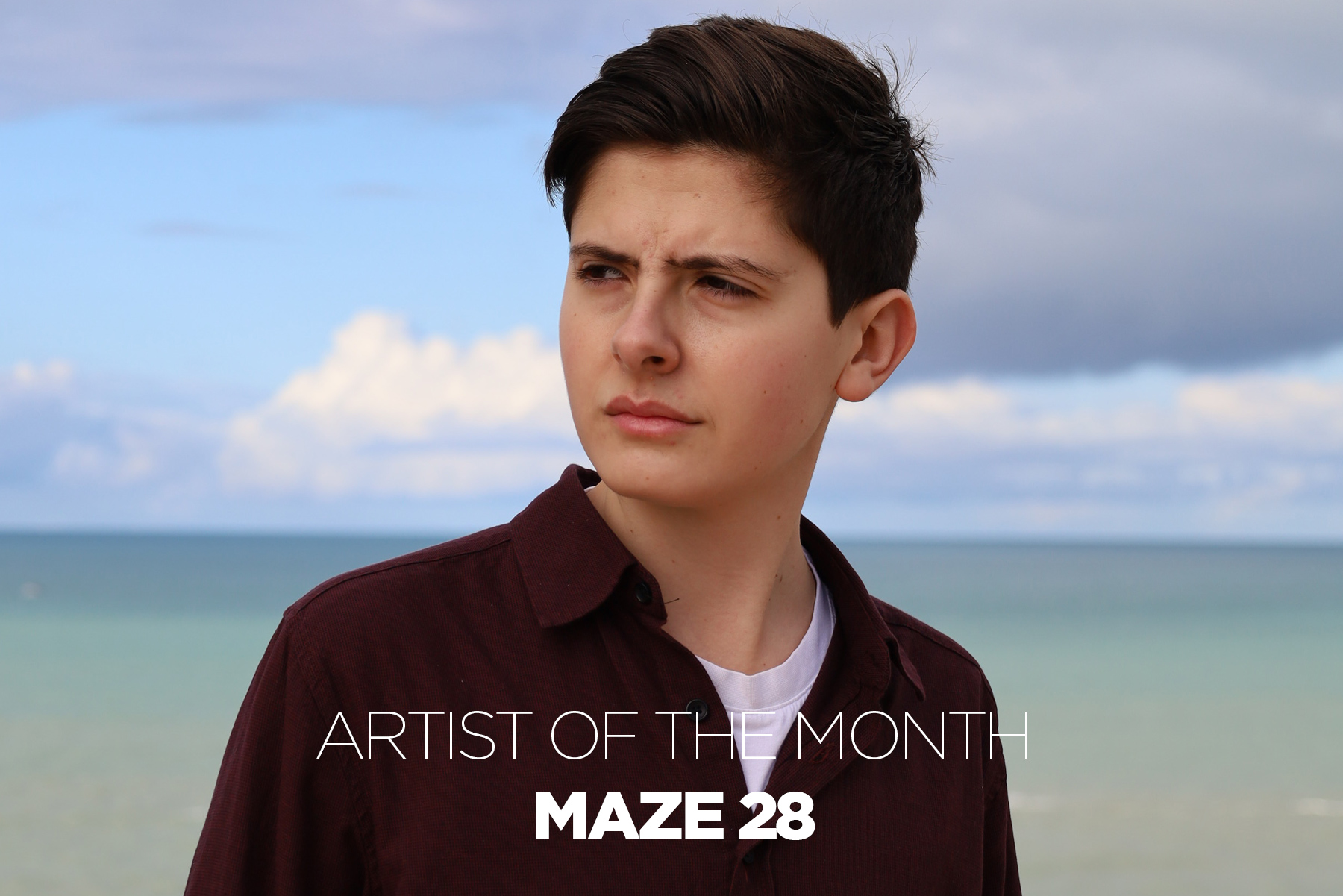
Mario Zefi, known as Maze 28, belongs to a new generation of producers whose artistic identity was not inherited from scene mythology or early immersion in underground culture, but constructed slowly through distance, curiosity, and eventual correction. His story is not one of precocious alignment with electronic music’s deeper currents, but of gradual reorientation: from mainstream EDM consumption toward a more introspective, narrative-driven understanding of sound. What defines him today is not the speed of his arrival, but the persistence of his recalibration.
Before any sense of artistic direction emerged, music existed in a fragmented and external way. “I first came in contact with music at a very young age; I must have been around 10 or 11,” he recalls. At the time, his listening habits were shaped by the dominant commercial ecosystem of electronic music: Spinnin’ Records, Revealed Recordings, and the broader festival-oriented EDM wave of the 2010s. Production followed a similarly exploratory path. Present, but not yet anchored by discipline or clarity. Music was one interest among many, secondary to school and sport, without a defined trajectory.
The turning point, when it arrived, was not the result of deliberate searching but chance exposure. In 2019, while completing a school assignment in an internet café, Maze 28 stumbled across Boris Brejcha’s 2018 Tomorrowland set. “It was the first time I heard music that wasn’t EDM like the music I was used to listening to, so it immediately got my attention,” he says. The opening track, ‘Take It Smart’, became a kind of rupture point — not just stylistically, but perceptually. What he encountered was not simply a different genre but a different architecture of rhythm, tension, and narrative pacing.
From that moment, exploration accelerated. Artists such as ARTBAT and Stan Kolev expanded his frame of reference, introducing him to melodic techno, indie dance, and early progressive house hybrids. But even in this phase of discovery, his sound remained transitional, caught between inherited habits and emerging instincts. It would take several more years and a deeper encounter with progressive house culture before a coherent identity began to form.
That shift was catalyzed through his connection with Argentine underground mainstay Ricky Ryan and the Electronic Groove Records ecosystem, where old-school progressive house functioned not as nostalgia, but as structural language. “The sound that I got to connect with and draw the most inspiration from was the old-school progressive sound,” he explains. It was here that Maze 28 began to separate surface influence from deeper musical philosophy. The emphasis moved away from trend absorption toward narrative construction — music as emotional sequencing rather than functional energy.
The process of arriving at that clarity, however, was slow and often unstable. Unlike artists whose early work quickly finds coherence, Maze 28 describes a prolonged period of technical and conceptual limitation. “I’ve been producing music for around 12–13 years, but for the majority of that time, my music didn’t sound professional,” he says. The issue was not lack of output, but lack of identity. A recurring gap between intention and execution.
That gap produced a psychological challenge that would become central to his development: completion. Even as technical ability improved, he struggled with finality. Tracks would evolve endlessly, judged and re-judged until abandoned altogether. “I used to get stuck on tracks for so long that I eventually ended up abandoning them,” he explains. Over time, however, this tension became productive rather than destructive. By 2022, his production began to stabilize, and by 2023, a shift into progressive house fully consolidated his direction.
The first clear external signal of that consolidation arrived with ‘Flux/Redux’, a two-track EP released on Mango Alley in 2023. The release marked a decisive moment; not because it reinvented his sound, but because it clarified it. “This was my first breakthrough moment,” he says. The EP positioned him within a lineage of progressive house artists operating in a more narrative and emotional register, while also introducing him to a wider network of collaborators and labels.
From there, his catalogue expanded into a series of releases that function less as isolated statements and more as interconnected steps in a larger formation. A remix for Rocio Portillo’s ‘Vivere’ reinforced his identity within high-energy progressive structures, while his work on Simos Tagias’ ‘Melted Pot’ further refined his balance between drive and atmosphere. His collaboration with Ricky Ryan on Futura City’s ‘Next Day Before’ marked another deepening of that relationship, consolidating a shared aesthetic language rooted in progression, restraint, and emotional layering.
In 2026, Maze 28 reached a new level of visibility through his inclusion on Anjunadeep, with ‘Tell Me Again’ featured on James Grant’s ‘Movement Vol. 6’. “This is a very big accomplishment for me,” he says. The significance of the release lies not only in label positioning, but in the implicit recognition of stylistic maturity; a sound now legible within one of progressive music’s most globally established frameworks.
Yet the most comprehensive articulation of his identity arrives in album form. ‘Leave The World Behind’, released on Mango Alley, stands as the central statement of his career to date. “The most important one is definitely my album,” he says. The 12-track project is structured as a dialogue between past influence and present identity: six solo productions and six collaborations with artists who have shaped his trajectory, including Ricky Ryan, Subandrio, GMJ, Paul Thomas, Weird Sounding Dude, and Alex O’Rion.

Rather than functioning as a compilation of individual tracks, the album operates as a mapped emotional arc; a synthesis of old-school progressive sensibilities with contemporary production clarity. Its significance lies not only in its collaborators, but in its coherence: a unified statement emerging from a previously fragmented process. It is the point at which Maze 28’s sound stops searching and begins articulating itself with intent.
Alongside solo work, collaboration has become a structural pillar of his development. Within Electronic Groove Records, his relationship with Ricky Ryan evolved from mentorship into shared authorship. Their early collaboration on a remix of Breeder’s ‘Tyrantanic’ — which went on to win a remix competition organized by legendary imprint Hooj Choons — marked the beginning of a deeper creative exchange. Over time, this partnership became central not only to production, but also to his role within the label itself.
As A&R for EGR, Maze 28 now contributes to shaping the label’s identity, selecting artists, and guiding releases. The ethos of the imprint (minimal branding, emphasis on sound, and a focus on progressive narrative structure) aligns closely with his own artistic philosophy. What began as an external affiliation has become an internal infrastructure.
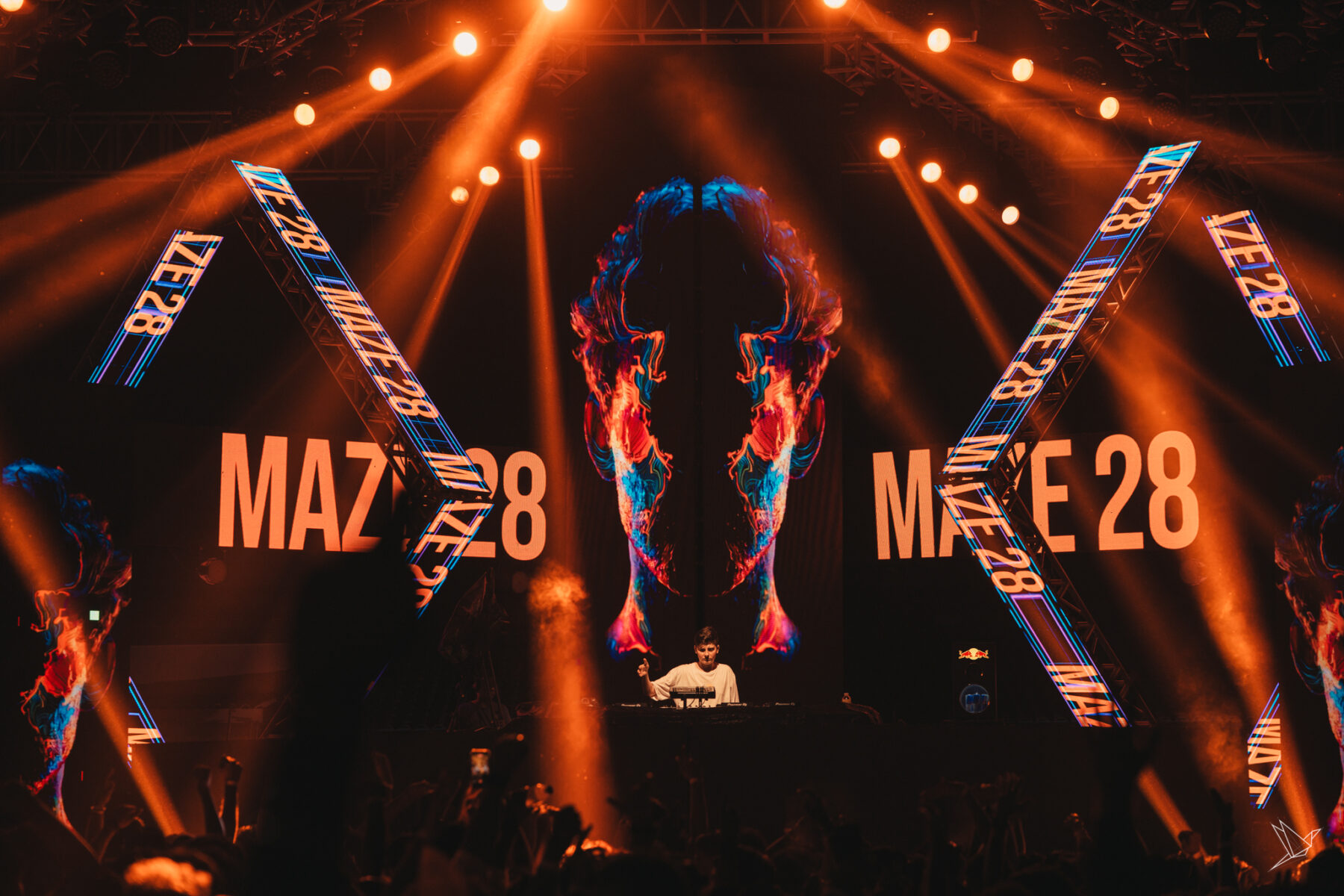
His approach to DJing reflects the same narrative orientation. “I believe that for a set to be great, it has to have a narrative, to tell a story,” he explains. In practice, this philosophy diverges depending on context. Live performances are often constructed around unreleased material, transforming each set into a temporary, unrepeatable archive of his production work. Recorded mixes, such as his ‘Altitude’ series, expand the palette further, incorporating deep techno, breakbeat, ambient, and atmospheric transitions that prioritize storytelling over genre consistency.
Across both formats, the objective remains constant: progression as emotional architecture, not just musical sequencing.
Looking ahead, Maze 28’s trajectory is defined less by reinvention than by accumulation. Upcoming releases across Anjunadeep Explorations, Balance Music, Meanwhile, Movement Recordings, and Electronic Groove Records indicate a widening scope, while festival appearances such as Balance Croatia place him within a broader international circuit. Yet even as visibility increases, his perspective remains anchored in process rather than outcome.
The long arc of his career is defined by gradual correction — from external listening habits to internal authorship, from imitation to intention, from unfinished fragments to structured narrative form. What distinguishes his path is not acceleration, but persistence through uncertainty. Maze 28’s work now exists at a point of equilibrium: not arrival, but alignment.
Follow Maze 28: Spotify | Instagram | YouTube | SoundCloud