

I-Robots has spent decades navigating the intersection of dancefloor culture, record collecting, and musical preservation.
Photo credit: I-Robots – Facebook
Known for uncovering overlooked corners of Italian club history, the Turin-based artist, DJ, producer, and archivist has dedicated much of his career to revisiting the sounds that shaped generations of dancers while placing them in a contemporary context.
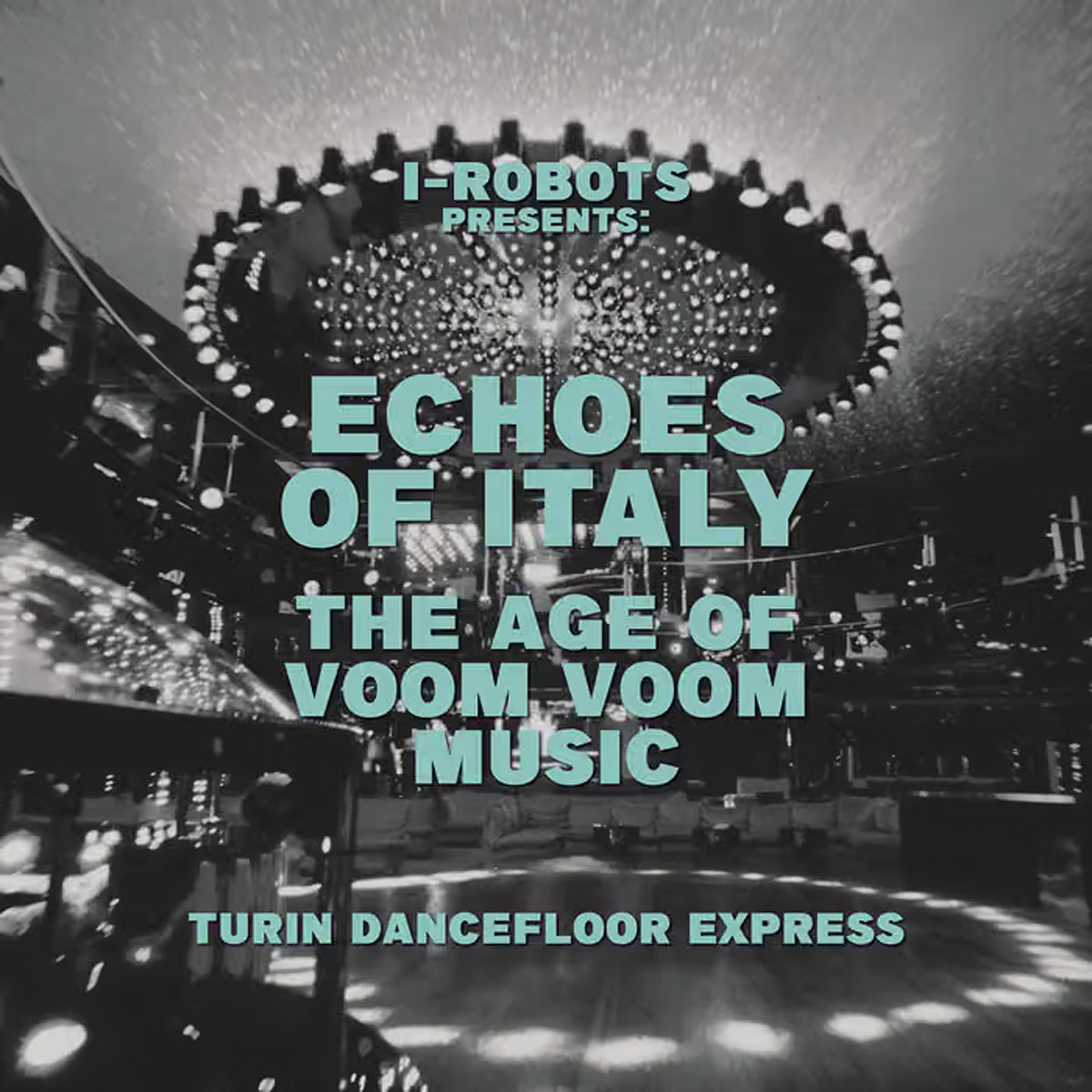
His latest project, ‘Echoes of Italy’, turns the spotlight toward Voom Voom Music, the influential Piedmont label founded by Ivo Lunardi. Drawing from original master tapes, unreleased recordings, and carefully crafted edits, the compilation explores a catalogue that stretched far beyond conventional Italo disco, blending soul, funk, rock, disco, and global influences into a distinctive musical identity.
In this conversation, I-Robots reflects on the origins of his passion for Italian underground sounds, the cultural evolution of Turin, the responsibility of preserving the Voom Voom archive, and why classic recordings can still resonate on modern dancefloors.
EG: Hi I-Robots, welcome to EG! What was the first record or moment that made you think: “I need to dedicate myself to rescuing this Italian/Italo-era sound”?
I-Robots: Thanks for the invite. As you surely know, I have been working on these kinds of Italo retrospectives since the early 2000s. Other similar projects were:
- I-Robots – Italo Electro Disco Underground Classics
- I-Robots – Turin Dancefloor Express (70s–80s Piedmont Area Italo Rare Grooves, Disco & Not Disco Sounds)
- I-Robots Presents Captain Torkive – Flying Saucers To Krypton
- I-Robots Turin Dancefloor Express Presents – Phantom Records
- I-Robots Turin Dancefloor Express Presents – Drums Edizioni Musicali
I have owned the Voom Voom Music master tapes since 2016, but I have been collecting this kind of material since the early ’80s.
Stratosferic Band and M’Bamina are the first artists that come to mind as early releases I was collecting from the Voom Voom Music catalogue at that time.
Of course, these days the Oxid tracks excited me much more when producing this compilation, because they are quite unique modern rock-disco tracks, and also because unreleased versions were found.
EG: Coming up in Turin, what did the city’s nightlife and music culture feel like at the time, and how did it shape your ear?
I-Robots: I’m not that old; I’ll be 58 on August 3, 2026, so I missed the ’70s Turin scene. But I had the pleasure of knowing almost all the artists, DJs, producers, and musicians involved from that era.
I started to become part of my city’s club scene step by step during the first half of the ’80s, but it was a time of change. The Italo-disco scene was very popular, maybe a little too commercial for my taste, even though it had been my first passion before I discovered the Afro-cosmic scene, which was already coming to an end between 1984 and 1986.
The alternative rock/wave scene was the real foundation of my city, Turin, and, interestingly, the house-music scene here came from that, not really from the disco scene as happened in the USA, probably because of the local DJs involved.
Artistically, I was growing in the middle of all this, and I also made changes that influenced my city: Italo and synth disco from 1981 to 1984, Afro-cosmic funky disco from 1984 to 1986, Chicago/Detroit house music from 1986 to 1990, then hip-hop, rare groove, and acid jazz from 1990 to 1998.
After 1998, I changed again, following trip-hop, leftfield and drum’n’bass, before starting with tribal and deep techno, which helped me return to the deep-house scene after a short time.
EG: You sit between DJ culture and preservation. Do you see yourself more as a dancefloor operator, an archivist, or a storyteller?
I-Robots: Maybe something like all of that, since I am a record collector and vinyl seller/trader. I love the old school of dance music, and this is what I always show through my selections and my productions.
EG: ‘Echoes of Italy’ is rooted in Voom Voom Music and Ivo Lunardi’s legacy. How would you describe Ivo’s role in the Piedmont scene beyond just “label owner”?
I-Robots: Ivo Lunardi was a pioneer with his Voom Voom Club, where people discovered soul, R&B, funk, reggae, and rock. Maybe he was the first to introduce Black American sounds in Turin.
To confirm that, just remember that in 1974, Voom Voom Music released the debut B.T. Express soul-funk album, ‘Do It (’Til You’re Satisfied)’.
His music background was obviously huge. Back in the ’90s, I met Ivo at Bar Biffi, his favourite coffee shop on Corso Vittorio Emanuele II in Turin, not far from where he lived. We met because I was interested in buying the old Voom Voom and Pick Up vinyl archives. Unfortunately, that didn’t happen, but we started talking about my DJ work and the clubs where I was performing.
Suddenly, he remembered a DJ who, years before, during one night at Cover Café in Turin, had played Jimmy Smith’s ‘The Cat’. He had really enjoyed it and found it unusual in that kind of venue.
That DJ was me.
“Old school is the new school — but obviously only in the hands of someone who can understand these sounds and communicate with the crowd through them”
EG: Since 2016, you’ve overseen the Voom Voom master tapes. What did it feel like the first time you realised the historical weight of what you were holding?
I-Robots: After Ivo passed away, I stayed in contact with his son Luca, who had obviously already heard about me and my DJ work.
He licensed the complete Voom Voom Music catalogue exclusively to me, giving me the original master tapes for Stratosferic Band and maybe the M’Bamina album; I don’t remember exactly now.
When Luca passed away, his mother Graziella, Ivo’s wife, made an impossible mission possible: she found all the other Voom Voom Music master tapes, including a few unreleased pieces.
She gave me all the material as a gift, together with Ivo’s Thorens TD 125 MKII and Pick Up’s Micro Seiki DQX 1000 turntables. It was an incredible moment in my life as a collector and as a producer.
EG: When you take stewardship of a catalogue, what’s your first practical step: cataloguing, assessing tape condition, rights, or deep listening?
I-Robots: When I take stewardship of a catalogue, I already own the masters or have the licences, and I usually know almost all the tracks apart from the unreleased versions that can be discovered on recovered master tapes. So I move forward with the digitisation process while planning the releases and promotion.
EG: Voom Voom Music’s identity is described as “eclectic yet visionary,” blending disco, pop, rock, and Black music influences. What defines that sound to you in real terms?
I-Robots: It is exactly that: eclectic and visionary. With Voom Voom Music, Ivo released interesting dance music that still sounds modern today, even if it is clear that this material was strongly influenced by the international sounds of that era, like KC & The Sunshine Band, Manu Dibango, Space, Rockets, Osibisa, and Van Morrison.
EG: How did you curate this compilation’s arc? Were you prioritising a Turin story, a label story, or what works on a modern dancefloor?
I-Robots: This project was done in honour of my friends Ivo and Luca, who trusted my artistic vision. The selected Voom Voom Music catalogue is a masterpiece of Turin and Italy, destined to cross eras and last through time.
Old school is the new school, but obviously only in the hands of someone who can understand these sounds and communicate with the crowd through them.
EG: You include both original versions and your “unreleased edits.” What makes you decide that an edit is necessary rather than letting the original speak for itself?
I-Robots: The tracks were too good and too short, so there was space and the opportunity to celebrate the material by improving it with a vision shaped by more than 50 years of experience.
EG: Your edits often reference specific years, like 1975 and 1977, and keep a “period truth.” How do you modernise functionally without sanding off the era?
I-Robots: These tracks do not really need a proper remix, but a re-edit can always maximise their power. Don’t forget that no multitracks were found.
I always find it funny to imagine myself in the studio, working alongside the artists and musicians during those eras. It is the same concept that inspired me, years ago, to create my reconstruction of Giorgio Moroder’s ‘Utopia’.
EG: From a technical standpoint, what’s your restoration mindset for master tapes: clean and polish, or preserve the grit and texture?
I-Robots: The master tapes were washed, warmed, and then digitised in a proper studio: Elettroformati in Milan.
EG: Low-end is everything in clubs. How do you approach bass and dynamics so these recordings translate on 2026 systems while staying faithful?
I-Robots: Fortunately, these master tapes already sounded really good, so I gave them just a small revamp while keeping the sound as close as possible to the originals.
“I love the old school of dance music, and this is what I always show through my selections and my productions”
EG: Tracks like ‘Lady Pick-Up’ and the wider catalogue openly nod to Black American grooves and global influences. How important is it to contextualise those roots when presenting this music today?
I-Robots: The tracks included in this release speak for themselves about their roots and about the musicians’ backgrounds. It is important to contextualise those roots when presenting this music today, especially for the crowd that is rediscovering Italian underground music, so it is not simply called “Italo” stuff.
EG: After ‘Echoes of Italy’, what’s next: deeper explorations, other Italian archives, or a left-turn into something new, and what’s your dream “lost tape” discovery?
I-Robots: I have been a bit quiet lately with productions, but I am working on several projects, including more retrospective series and, of course, something new.
I-Robots’ ‘Echoes of Italy’ is out now. Stream and download your copy here.