Artists are now closer than ever to financial independence.
Photo by Haithem Ferdi on Unsplash
In a landmark decision poised to recalibrate the economics of modern music, Spotify has officially announced an increase in its per-stream payout, raising the rate from an estimated $0.0030–$0.0050 to what insiders describe as a “more artist-forward” figure hovering closer to $0.00318.
The adjustment, framed as a decisive leap forward, arrives amid growing scrutiny over streaming-era compensation models. According to company statements, the revised rate underscores a “deepened commitment to the global creative community,” while reinforcing Spotify’s position as a platform where artists can “not only be discovered, but sustained.”
For context, one million streams, long considered a symbolic benchmark in the digital music economy, could now yield approximately $3,180, up from a previous range that often landed closer to $3,000. Executives have described this as a “meaningful uplift,” particularly when aggregated across catalogs, territories, and multi-year growth trajectories.
“This is about progress,” a spokesperson for the streaming giant explained. “We’re constantly refining how value flows through the ecosystem. Even incremental changes, at scale, can have a significant impact.”
That scale, of course, remains the operative word. With over 100,000 tracks uploaded daily, the platform’s vast architecture continues to reward those capable of generating sustained, high-volume engagement, typically a narrow segment of global superstars and algorithmically favored acts.
For independent and mid-level artists, the updated figures suggest a slightly more efficient pathway toward covering basic production costs, provided their music resonates with hundreds of thousands, if not millions, of listeners.
Industry analysts have been quick to note the precision of the increase, pointing to its careful calibration. “It’s a fascinating number,” one observer remarked. “Large enough to communicate intent, small enough to preserve the existing economic framework.”
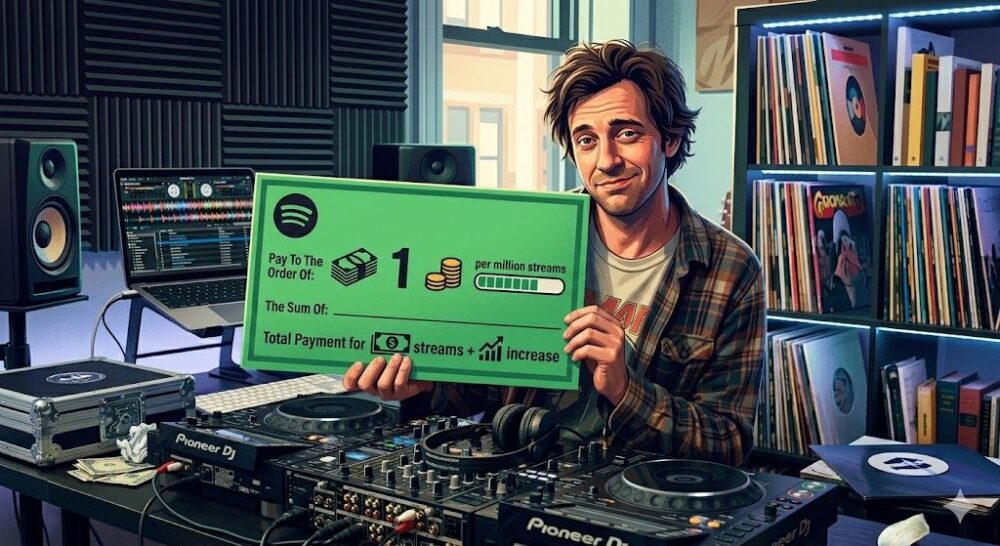
Artists, meanwhile, have greeted the news with a mix of gratitude and quiet recalculation. “It definitely changes things,” said one electronic producer who asked to remain nameless. “At this rate, I might be able to upgrade from instant noodles to something with actual texture—assuming the next million streams come through.”
Critics argue that the move does little to address the structural imbalance at the heart of streaming economics, where the overwhelming majority of revenue continues to concentrate among the platform’s top-tier performers. Still, the announcement arrives wrapped in the language of evolution: a system gradually improving, one decimal point at a time.
While Spotify has not confirmed whether further increases are imminent, sources suggest that ongoing “optimizations” remain part of its long-term roadmap. For now, the update stands as a reminder that in the streaming era, progress is measurable, not in leaps, but in the subtle, almost imperceptible movement of numbers.
And for artists everywhere, those numbers continue to define the distance between exposure and sustainability.