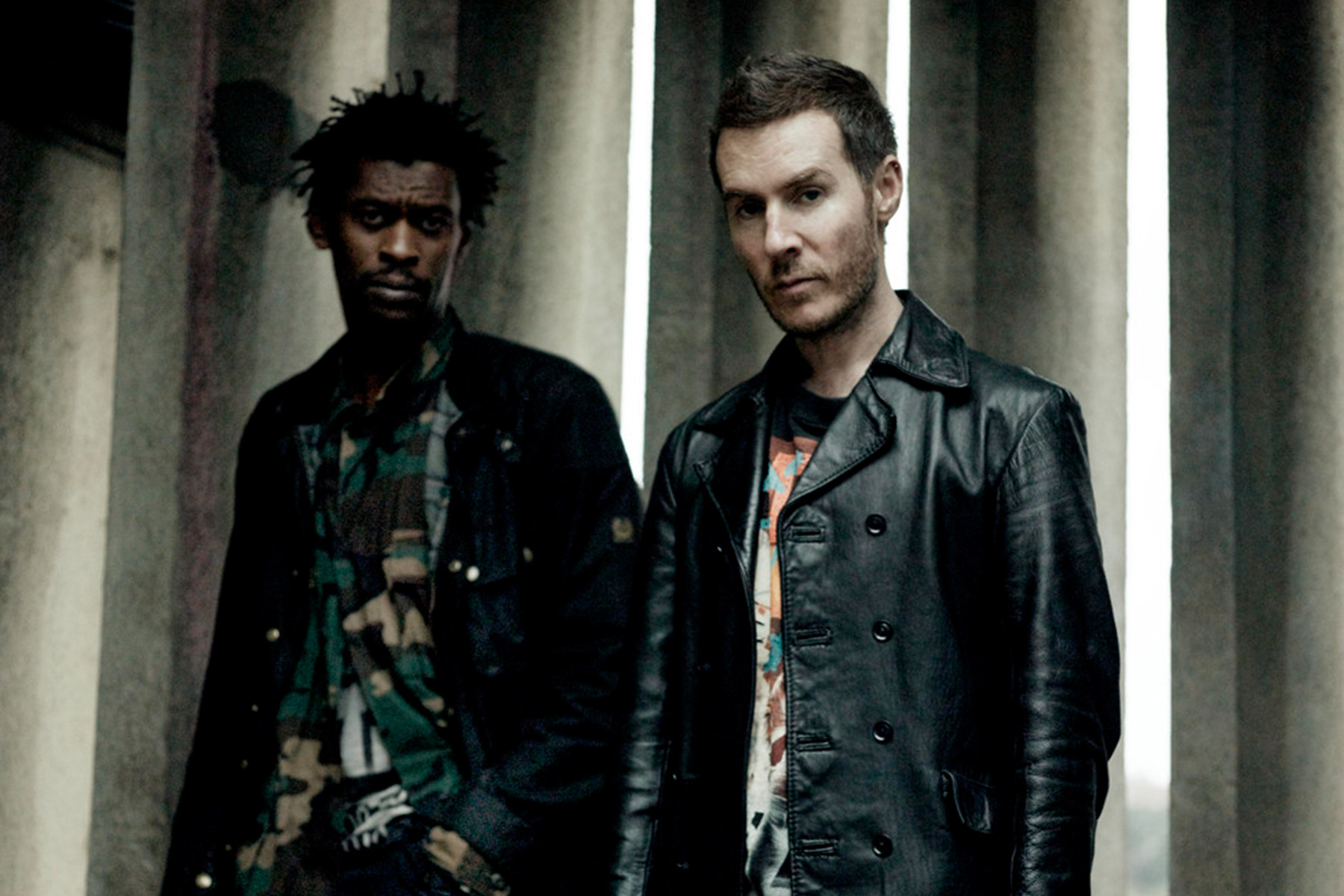

Andrea Chirivl, better known as Purple Tape, is an Italian electronic music producer, DJ, curator, and founder of Desert Vision, the imprint behind what he describes as the Adriatic Indie Dance sound.
Photo credit: Purple Tape – Official
Drawing from Mediterranean influences, Middle Eastern textures, and a background that stretches from classical music to hip hop, his work explores the relationship between movement, place, and cultural memory.
Alongside his own productions, Purple Tape has spent the past few years developing Desert Vision into a platform that extends beyond music releases, connecting artists, events, and creative communities through a carefully curated vision. The label’s latest release, ‘Keep It Yard, Vol. 1’, continues that approach with contributions from Paul Robson, Lishay Bachar, Saporta, and Purple Tape himself.
In this conversation, Purple Tape reflects on the philosophy behind Desert Vision, the emergence of Adriatic Indie Dance, his creative process, and the ambitions shaping the label’s future.
EG: Hi Andrea, welcome to Electronic Groove. It’s great to have you with us. How have you been lately, and what’s been occupying most of your creative energy these days?
Purple Tape: Thanks for having me. Honestly, it’s been one of those summers where everything lands at once, in the best way. It’s release week for ‘Keep It Yard, Vol. 1’, so most of my energy goes into watching the record leave my hands and start belonging to platforms and dancefloors. That handover is my favourite part of the job. You spend months obsessing over details nobody will ever consciously notice, and then one day the music simply isn’t yours anymore.
The rest of my head is already in the next chapters. We’re preparing something special to close the summer season on our coast, and in October we’re bringing a Berlin live act to Italy for two nights I really care about. So it’s a season of very little sleep and a lot of gratitude.
EG: Your latest release, ‘Keep It Yard’, arrives as a various artists compilation featuring Paul Robson, Lishay Bachar, Saporta, and yourself. What was the vision behind bringing these particular artists together for this project?
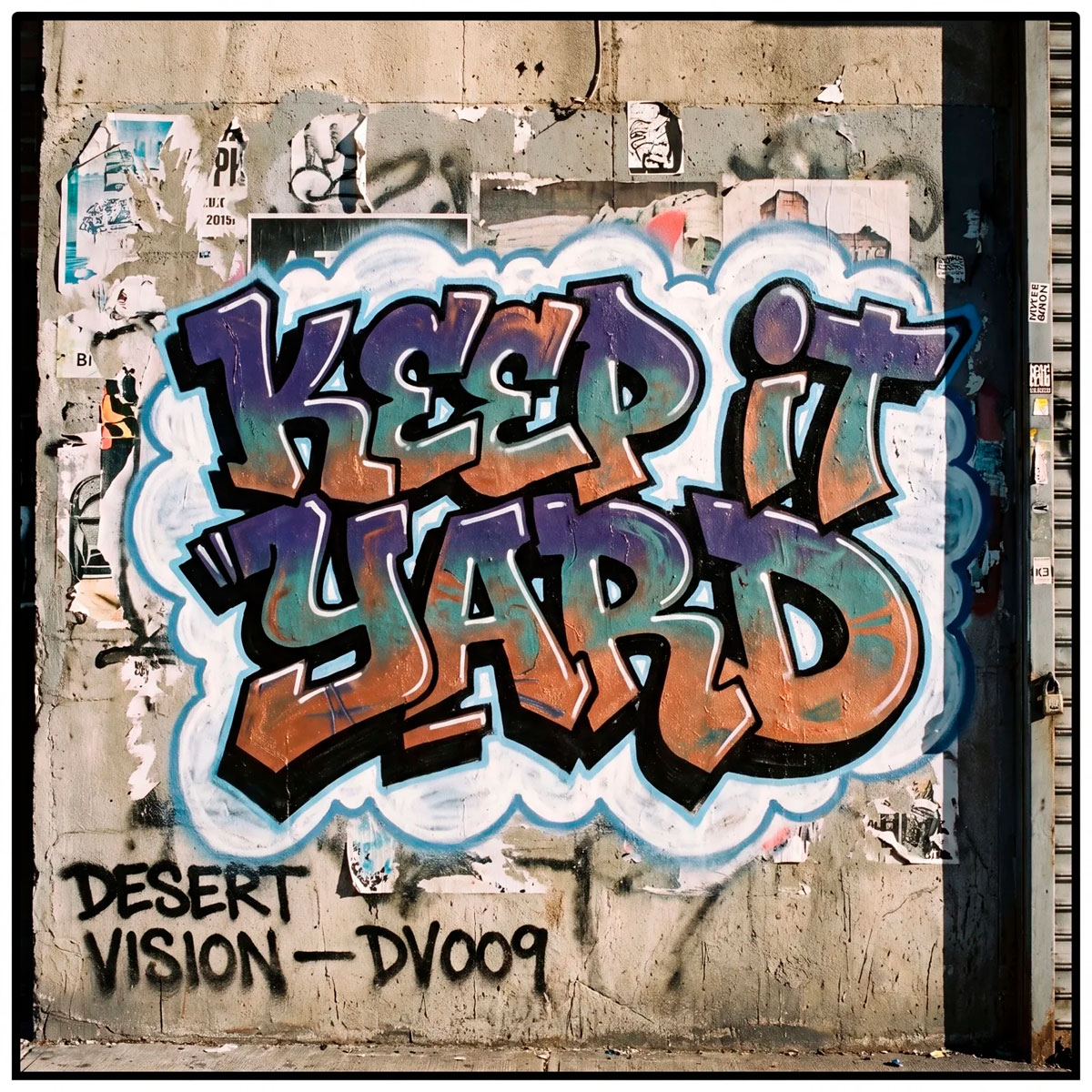
Purple Tape: Four artists, four cities, one wall. ‘Yard’ is a word I carry from my hip hop years. The yard is where writers paint, but it’s also simply your ground, the place your style comes from.
There was no brief and no commission behind this record. These tracks reached me the way music naturally reaches a label, through the promos and submissions I receive, and my work was in the selection, putting them together with a clear criterion until four very different accents sounded like one conversation on the same wall.
Saporta has been part of Desert Vision since day one, because here he’s always found a creative space where he can express himself freely, and every time it’s a pleasure to see what he pulls out when nothing is holding him back. Lishay had already released on Desert Vision with another project, so the trust was there. And Paul Robson is a great DJ and producer from Boston, with an attitude completely in line with the label. Working with him was a pleasure as well.
EG: The release comes through your own label, Desert Vision. For those discovering it for the first time, what is the core philosophy behind the label, and what does the term “Adriatic Indie Dance” mean to you?
Purple Tape: Desert Vision started in 2023 with one rule: curation before quantity. Every release is a designed object, music, visuals, and story built together, never an afterthought. If a record doesn’t deserve that treatment, we simply don’t put it out.
‘Adriatic Indie Dance’ is my way of claiming a lineage. This coast has a secret dance history most of the world never heard, the afro and cosmic scene that lived here for decades, from Daniele Baldelli onwards. Those DJs treated the booth like a laboratory and played music from everywhere to rooms that came to dance with total freedom.
What we do today is that story continued with new tools. So Adriatic isn’t geography for me. It’s a sound and an attitude: warm, open-minded, a bit salty, deeply connected to the dancefloor. When someone in another country plays one of our records, and something of this coast reaches them, that’s the label doing its job.
EG: Desert Vision has grown remarkably since launching in 2023, connecting artists from multiple countries and earning support from influential platforms and events around the world. What have been some of the most rewarding moments of building the label so far?
Purple Tape: Two moments, one quiet and one loud.
The quiet one was releasing DJ Alpha’s ‘Maharaja’, his tribute to Gianni Maselli, a pioneer of the Adriatic afro scene and the mind behind the ‘Adriatic System’ series. Alpha has been a brother and a mentor to me for over ten years, and that record tied the label to the generation who literally invented dancing on this coast. It closed a circle that matters more to me than any chart.
The loud one is the Stroopwafel series, a joke about a Dutch biscuit that got completely out of hand. I studied the whole stroopwafel world after a trip to Holland, made a funky, slightly psychedelic track with Tal Tobi about it, and it grew into remixes and release parties in Paris and Barcelona, and finally KITA’s remix from Brooklyn, which moved the whole visual world onto the New York subway.
At one point I imported an actual stroopwafel machine and we were baking Desert Vision waffles at a DJ set in the middle of Ancona’s Christmas markets. That’s the reward for me, watching a release stop being a file and become a place people can walk into.
“I’ve stopped trying to resolve the collision. The collision is the identity”
EG: Your music often blends Mediterranean influences, Middle Eastern textures, organic instrumentation, and electronic club energy. How did this unique sonic identity develop over time?
Purple Tape: By collision, honestly. I grew up in a classical house; both my parents are flutists, so my childhood soundtrack was conservatory, opera, and symphonic music. Discipline and beauty, every day. My older sister smuggled in the other side, cassettes of the afro and cosmic music that lived on this coast, which felt like a secret radio station from another planet. Then hip hop hit me at fourteen and I started making beats. That was the moment music went from something I studied to something I built.
Later, the academic side gave me one more lens on the same obsession. So when people hear Mediterranean colours or Middle Eastern textures in my music, they’re hearing one chapter of a longer story. The foundations are older. Classical breath, afro freedom, hip hop attitude. I’ve stopped trying to resolve the collision. The collision is the identity.
EG: Ancona is not the first city people typically associate with electronic music, yet it plays a central role in your story. How has growing up and creating from the Adriatic coast influenced both your sound and your perspective on music culture?
Purple Tape: That’s the whole point, and it’s hidden in the label’s name. Desert Vision means seeing an oasis where others only saw desert. Most people here with ambition leave for Milan or abroad, wherever the infrastructure already exists. I understand it, but I made the opposite bet. I stayed and built the circuit from here. And it worked. I brought Tal Tobi to play the Rotonda a Mare in Senigallia, a stage built over the sea, one of the most beautiful places you can put a DJ. Saporta has come over from Valencia many times, and we’ve also hosted various guests from Barcelona and Ibiza. Artists travelling to the Adriatic, not the other way around.
Growing up here also shaped the sound itself. This coast teaches you patience and warmth, and it keeps you honest, because there’s no scene machinery to hide behind. Either the night is real, or it isn’t. The desert was never empty. It was fertile ground nobody had cultivated with international ambition. Someone just had to decide to see the oasis.
EG: You describe yourself not only as an artist but also as a curator and cultural builder. How do those different roles complement one another, and what have they taught you about the wider electronic music ecosystem?
Purple Tape: They’re really one skill pointed in different directions, reading a room. I learned it the long way, playing everything, everywhere, for hours. Beach clubs from morning to night, every genre imaginable, watching what a track does to a space in real time. That education never leaves you.
As a curator, I treat a compilation exactly like a set. Narrative, not collection. Track order, artwork, the story around the music, it all has to breathe together. One of my favourite curatorial jobs ever was building an entire selection around a Marc Chagall exhibition, translating his suspension and lightness into sound for people walking through the paintings. At that level, DJing is closer to painting a space than playing records.
What all of this taught me about the wider ecosystem is simple. The industry rewards noise, but the culture rewards care. Platforms come and go, algorithms change, but a room that has been read well remembers you. I build everything on that second economy, the label, the events, the records.
EG: Looking specifically at ‘Keep It Yard’, is there a particular track on the compilation that best represents where Desert Vision is headed creatively right now?
Purple Tape: Honestly, I’m more attached to the release as a whole than to any single track off it. What I love about ‘Keep It Yard’ is that every piece stays true to its own sound instead of chasing the others, and that’s the value I actually care about here, more than picking a favourite.
But if I have to name one track from the compilation that best represents where Desert Vision is headed creatively right now, I’d point to Lishay Bachar’s ‘Let’s Go’. It’s rough on purpose, a handful of elements that actually talk to each other instead of fighting for space, nothing decorative sitting on top. If Desert Vision has a compass right now, it’s that instinct. Stay rough. Stay true to your sound. Let the track be exactly what it is.
EG: Before electronic music became your primary language, you studied and played the flute. Do traces of that musical background still find their way into your productions today?
Purple Tape: More than people expect, and in a way that took me years to notice myself. Flute is a monodic instrument, one note at a time, so everything it teaches you lives in the horizontal, in the melody, in how a phrase moves through time and breathes. It’s also an incredibly evocative instrument on its own; it can carry a mood with almost nothing behind it.
I’ve actually picked it back up on record more than once, most directly on ‘Azalai’, where the flute is playing, not just referenced. But the strange part is what that background actually gave me for production, and it’s almost the opposite of what you’d expect. A monodic instrument has no harmony built into it, so every time you play or write for one, you’re forced to hear the vertical dimension that isn’t there, the chords implied underneath a single line, what has to stack around it to hold it up. That’s the muscle I use constantly now, not on melody, but on arrangement, on how many layers can sit on top of each other before the track loses clarity. The horizontal instrument is what taught me to hear the vertical.
“Stay rough. Stay true to your sound. Let the track be exactly what it is”
EG: The electronic scene often moves at an incredibly fast pace. How do you balance staying relevant and forward-thinking while preserving a strong sense of identity and authenticity?
Purple Tape: I stole the answer from hip hop, where I come from. In that culture, nobody cared about your image; they cared whether you could actually do it. Skills over image. Your showcase was your argument.
I’ve been close enough to the commercial side of this industry to know that road well: big rooms, big machinery, and at some point I understood that to keep growing there I’d have to become a picture of myself. A well-produced, well-lit picture, but a picture. So I walked, and I built my own thing instead.
Now my filter for every opportunity is simple. Does this make the work better, or just louder? If it’s louder, I pass, even when it stings. Trends come and go. Style stays. The artists I respect most have all figured out some version of that. The scene moves fast, but it keeps circling back to the people who stayed themselves while it was moving.
EG: Looking ahead, what are your ambitions for Desert Vision over the next few years, both as a label and as a broader cultural platform?
Purple Tape: To prove that a world-class platform can be rooted in a place like Ancona. That’s the long game, and everything else serves it. On the label side, it means keeping the curation tight and letting the roster’s voices grow. On the cultural side, we build formats, not parties. OFFSHORE is the clearest example, our floating club, where the sea itself becomes the venue. A party ends at sunrise. A format keeps producing meaning year after year. And above it all, the real ambition is making ‘Adriatic’ mean something in electronic music the way ‘Balearic’ came to mean something. A sound, a coast, a scene, a way of doing things. We didn’t invent this coast’s dance culture; we inherited it. The job is making sure it travels.
EG: Finally, what can fans expect from Purple Tape in the coming months, and are there any upcoming projects, collaborations, or events that you’re particularly excited about?
Purple Tape: ‘Keep It Yard, Vol. 1’ lands July 31st, with the premiere running on Now We Deep. That’s the immediate one, and I can’t wait for these four tracks to be everyone’s. Then we’re preparing something special to close the summer season on the Adriatic. I won’t say more yet, but if you’ve followed what we do with OFFSHORE, you know the sea is never far from our plans.
And October is the one I’m most excited about. We’re bringing Andy’s Echo, a phenomenal live act from Berlin, to Italy, Milan first and then a hometown show in Ancona on October 10th. Bringing an artist of that level to my coast, through my own platform, is the entire Desert Vision idea condensed into one night. Beyond that, there’s new Purple Tape music taking shape in the studio, and the ‘Keep It Yard’ wall has more room on it. Let’s just say the spray cans aren’t going back in the box.
EG: Thank you so much for your time, Andrea. We wish you all the best with ‘Keep It Yard’, Desert Vision, and everything ahead. Take care!
Purple Tape: Thank you, it’s been a pleasure. Keep it up!
Purple Tape’s ‘Keep It Yard, Vol. 1’ is out now via Desert Vision. Stream and download your copy here.
Follow Purple Tape: Spotify | SoundCloud | Instagram