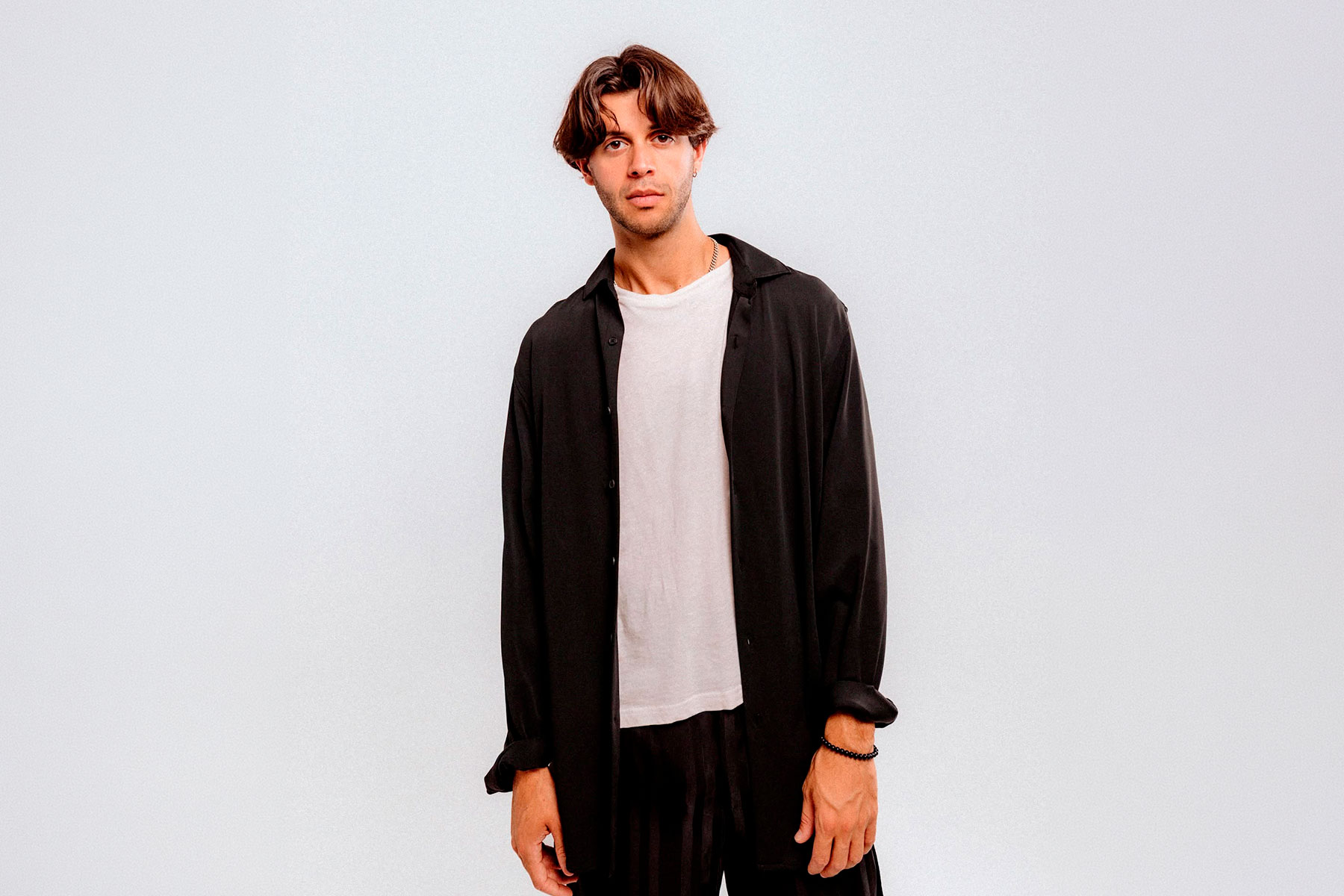
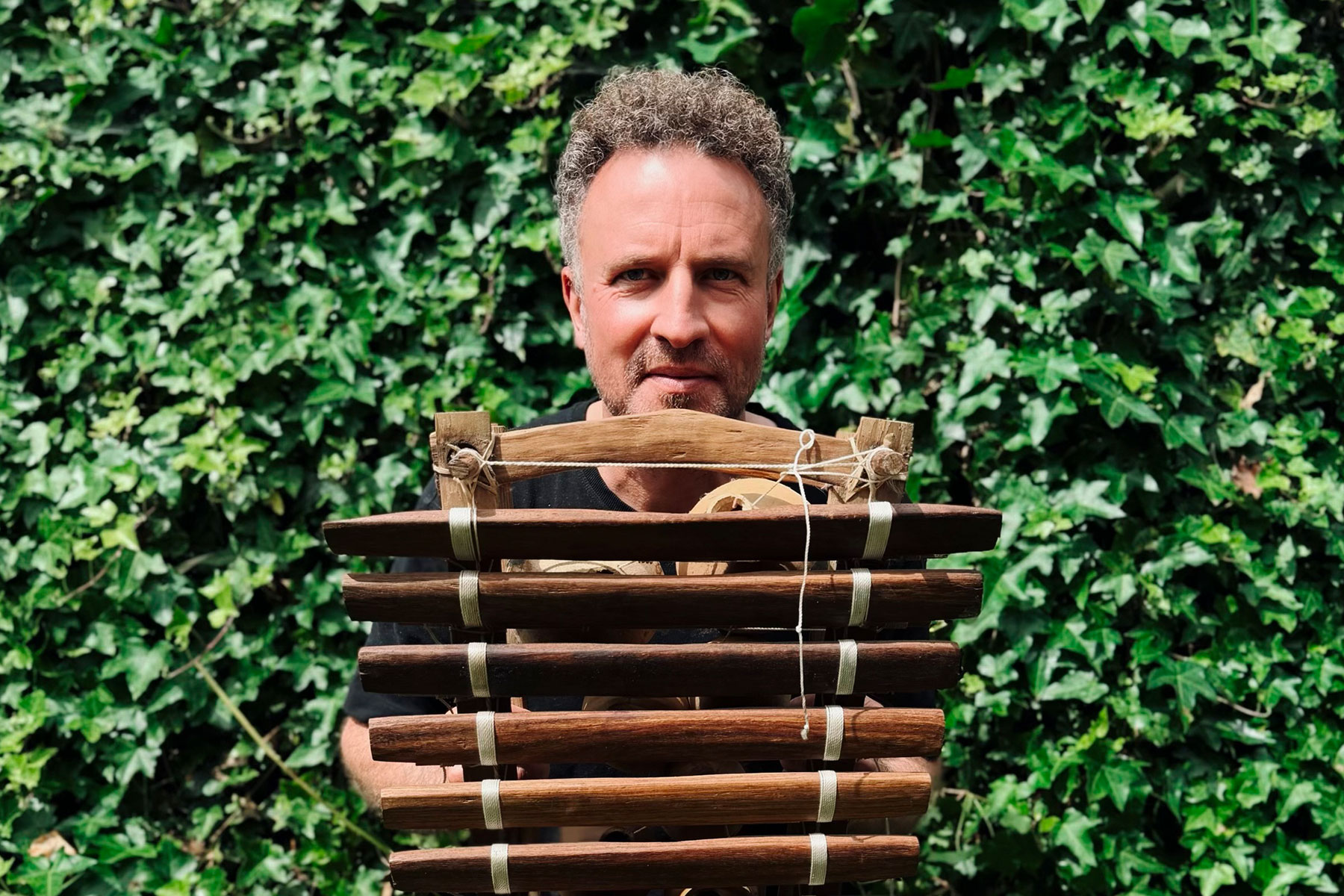
Balaphonic, aka Danny Ward, has spent three decades working across music as a drummer, producer, composer, and DJ. His career includes the Dubble D and Moodymanc projects, his work with 20:20 Soundsystem, and performances with Fila Brazillia, Rae & Christian, The Pharcyde, Mat Halsall, and Nat Birchall.
Photo credit: Balaphonic – Official
His credits also include collaborations with Flora Purim and Nightmares on Wax, alongside his connection to Leeds’ Back to Basics.
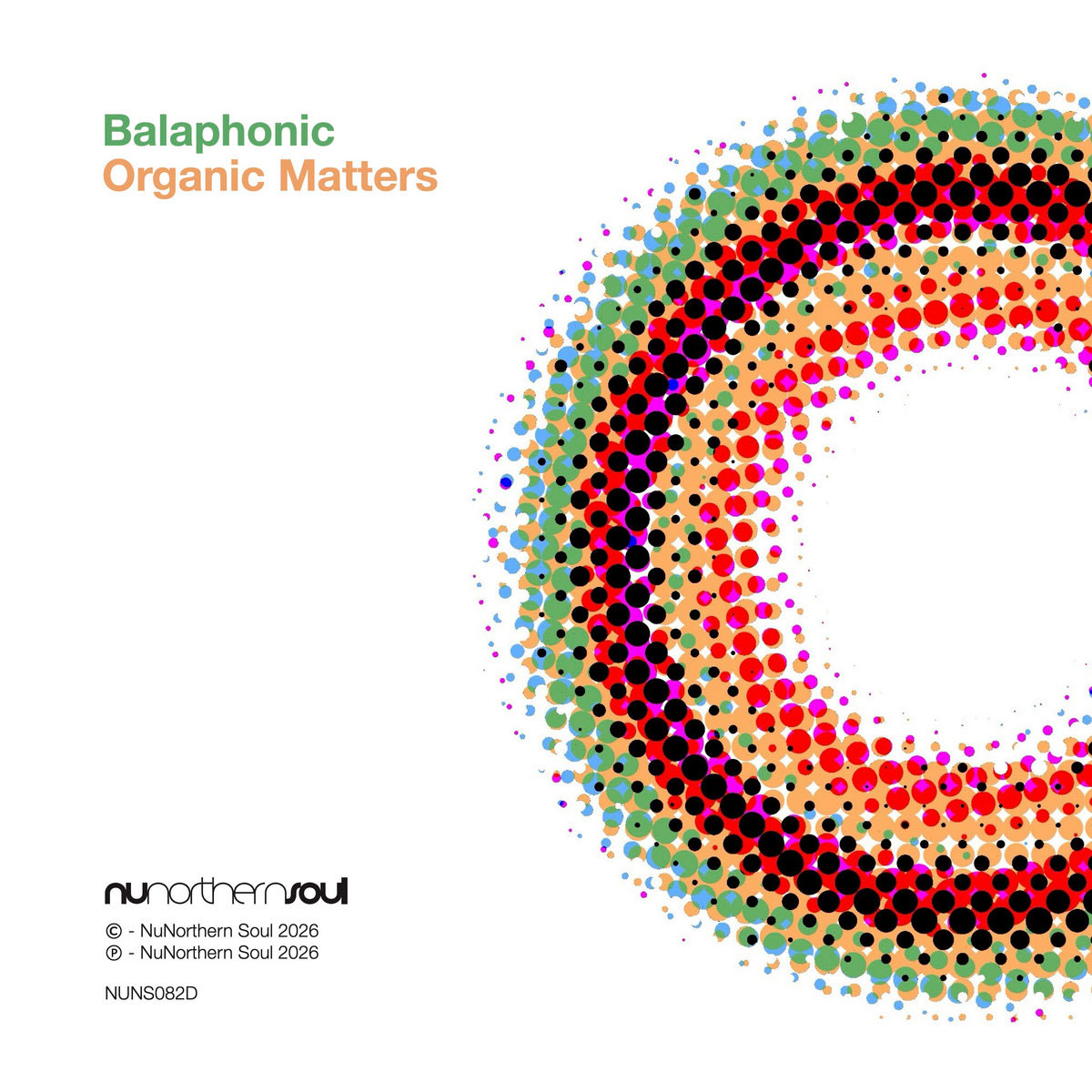
Set for release on August 12th, ‘Organic Matters’ expands Balaphonic’s percussion-led sound through acoustic instrumentation and a broad network of collaborators. Across the record, Ward allows individual instruments and performances to guide each track rather than working toward a predetermined genre or scene.
In this conversation, Balaphonic discusses the ideas behind ‘Organic Matters’, his relationship with live instrumentation, and the experiences that have shaped his approach to music.
EG: Hi Danny, welcome to Electronic Groove. It’s a pleasure to have you with us. How have you been, and what has been inspiring you creatively as you prepare to release ‘Organic Matters’?
Balaphonic: Thanks so much for having me! I’ve been great, thanks, indeed, very lucky to be busy in the studio working on various projects, out DJing and playing drums regularly and, of course, digging through records and releases, old and new. The eternal quest! All of which were, and continue to be, the main sources of inspiration.
EG: ‘Organic Matters’ feels like a natural continuation of the Balaphonic journey while also expanding its musical palette. What was the central idea or feeling you wanted to explore across this new collection of tracks?
Balaphonic: That’s lovely to hear, thanks. The last record, ‘Resolution Revolutions’, was a very honest release in the respect that the tracks were made without any preconceived idea of fitting into any specific genre or appealing to one specific ‘crowd’ or ‘scene’. As such, I was really blown away by the positive response, and it really gave me confidence in delving a little deeper whilst retaining that concept.
I decided on the name ‘Organic Matters’ for a couple of reasons: most immediately, of course, in that the main core of the instrumentation is from acoustic sources, but also that I generally started with one instrument, playing with it and allowing it to guide the direction and development of each track rather than trying to impose anything stylistically or otherwise.
In the main, I similarly approached the collaborations, letting the artists’ ideas and performances shape the overall sound, feel and direction of each track.
EG: One of the defining characteristics of Balaphonic is the way it brings together influences from Afro-Cuban, Brazilian, Balearic, dub, and deep house traditions. How do you approach blending such diverse musical languages into something that feels cohesive and uniquely yours?
Balaphonic: I’m first and foremost a drum kit player. The wonderful thing about that is that you can trace and study it as an instrument right back to its inception in the early 20th century. It developed alongside the development of Black American music, both in terms of instrumentation and language, and obviously influenced the language of electronic music that came out of that.
There’s a reason that the constituent parts of even the most abstract techno still revolve around a ‘kick, hi-hat and snare’ of some description; it’s all rooted, so if you study that, you definitely start to understand and connect with a lot of ‘modern’ Black music.
The more I got into Jazz music and records, the more I started to discover Brazilian, African and Afro-Cuban rhythms. Around the age of 16, I went halves on a beat-up pair of congas with a schoolmate, Chris Sykes, who is also a fantastic and well-accomplished drummer to this day, and I started to study and hang out with some Manchester percussionists, perhaps most notably Chris Cruiks, who was also a DJ at the legendary PSV club in Hulme and at Back to Basics in Leeds; obviously a huge influence in the direction I took in both life and music.
Of course, this was a time when House music and Techno were exploding here, and I was as keen a clubber as I was a musician. We started to play in clubs alongside DJs but introduced Afro-Cuban and Brazilian rhythms and patterns as we’d been studying, and I slowly started to join the dots.
This was in conjunction with collecting records and music and further rooting for information and study wherever possible, no mean feat pre-internet, but perhaps all the more valuable for it.
I was also playing in various bands, gigging regularly with Jazz projects and starting to write and produce music myself and with others, but also, for a while, playing a lot of reggae and dub. I still play with an 11-piece Ska band to this day!
I spent a lot of time with a friend and artist, Dubdadda—Johno!—not only playing but in the studio, watching him create dubs with a couple of effects units and an 8-track, which was mesmerising and completely inspiring. It still informs my production and DJing to this day.
We also would occasionally have Clive ‘Freedom Masses’ Wilkes on our live sound, who was a complete master. Well worth checking his Sound System out to this day if you get a chance.
I was and still am a complete sponge, and an obsessive. Probably something that most DJs and musicians share. For me, it meant diving headlong into all sorts of different genres of music, but as a drummer, percussionist, dancer and DJ, it was never really anything but organic. I was just drawing the dots.
There are, of course, fine lines to be drawn here. I feel it’s important to wear your influences on your sleeve and be reverent to your sources, but increasingly of late, and quite rightly, we are much more aware of ‘cultural appropriation’.
As such, I’m flattered that you might hear all of those influences in my music, because they’re definitely there, but also that you might understand that they’re there because it’s really all a representation of my coming to terms with it all, ultimately through my dot-joining journey and through a Mancunian melting-pot lens! It’s definitely all about trying to tell my own story.
In terms of musical traditions, I’m quite possibly breaking some rules, but hopefully people might understand that it comes from a place of respect and honesty and can relate.
On the whole, I’ve been really lucky in this respect; I’ve always felt a lot of support here in the UK and Europe, but significantly in the U.S., and more recently, especially through the Ocean Waves Brasil collaborations, one of which features on the last Balaphonic ‘Resolution Revolutions’ record, in Brazil.
EG: The EP opens with ‘Dew Drops’, a collaboration with Robin Dewhurst. Can you tell us about that creative partnership and what made this track the right introduction to the record?
Balaphonic: I’ve known Robin principally as a jazz pianist, and we’ve done a squillion gigs together in all sorts of settings as such, though he’s also a composer and arranger of international repute, a Doctor indeed!
Robin is a fantastic musician to play with. His phrasing, timing and rhythm are impeccable, but he also has a deep knowledge of records and is incredibly quick-witted; he’s very good in a jazz context in ‘setting you up’ as a drummer. Just like a great DJ, he’s quick to know the records you might know and love but present those ideas in fresh context… His sense of harmony is just as sharp and, as such, he’s an incredibly in-demand accompanist. He has prodigious technical ability as a player, but it never clouds his musicality. This is a rare and beautiful thing.
I was really honoured, and a little daunted tbh, when I asked him if he might like to collaborate on a track, but what blew me away was that he initially came back to me with some very simple and beautiful textures and motifs rather than a lot of flash soloing.
More so, he’d done this in a very mindful way of supporting the tonality of my balafon; most things Balaphonic still start with a balafon.
We share a mutual love of the pianist Ahmad Jamal; if you don’t know it, check out ‘Live at The Pershing,’ and those motifs have a definite ‘Ahmad’ quality. I expanded the arrangement, recording more percussion to fit, and doubled the phrases on xylophone, a new purchase since the last record.
As the track developed, I really felt a Pharoah Sanders “Hum-Allah-Hum-Allah-Hum-Allah” vibe developing, a loose but hypnotic groove, with the prayer bells, which I bought on holiday in Greece, giving the floating backdrop.
This led me to think about Alice Coltrane records, so I asked Robin if he could provide some harp. What he came back with felt truly transcendental.
It was a very uplifting and affirming process, full of love, and I felt that really translated through the track, but this was also what I wanted the record as a whole to convey and, as such, it felt like the perfect way to set the tone as the opener.
EG: ‘Switch’ sees you revisiting a composition originally written in 2005, this time featuring Flora Purim and Diana Moreira Purim. What inspired you to return to this piece, and what was it like working with artists so closely connected to the music that influenced you?
Balaphonic: The collaboration with Flora and Diana came about when I was in the finishing stages of my first ‘Dubble D’ album in the mid-00s.
I’d been lucky to collaborate with some of the friends and artists I’d been working with as a drummer and in the studio over the years—Diane Charlemagne, Q n C, Kate Rogers, Dubdadda, Nightmares on Wax—but the label, 2020Vision, were keen to get another featured artist and had suggested various people.
All really great in their own right, but, as I explained, they didn’t really resonate with my journey musically.
Andy Whittaker, who was A&R there at the time, I think out of frustration, it was he who eventually started calling me ‘Moodymanc’, challenged me: “Ok. If you could have any vocalist in the world on this album, regardless… who would it be?”
Without hesitation, I answered ‘Flora Purim’. I’d been mesmerised by her from first hearing ‘500 Miles High’ on a Walkman Jazz Chick Corea compilation cassette bought with a book voucher at WHSmith at the age of 15! I added that he might have an ‘in’ in that her husband Airto had borrowed drums from me on recent UK gigs…
All credit due, he chased her down through her management and sent a bunch of music I’d been working on, and she chose what would become the version of ‘Switch’ on ‘Reachin’ Out!’. I was already gobsmacked.
She sent vocals through that were wonderful, the hook and improvised passages, all nicely arranged and edited, but I asked if I could get the whole session, outtakes and all.
When I got them, I discovered all these other vocals, a similar voice to Flora, but with a definite ‘other’ quality which I loved; so did my version with them included and sent the track back.
The response wasn’t quickly forthcoming, so I began to worry she must have hated what I’d done and sent a message to say it was fine if so, and I’d be more than happy to revert to the original version she’d sent.
I got a reply back to say that she absolutely loved it but had been worried because she’d done the initial session jamming with her daughter, Diana, and thought I might be disappointed to find it wasn’t all just her.
Of course, quite the opposite for us, and she responded that she was so pleased because it was the first time they’d appeared on a record together… Perhaps the only thing that topped it was getting a Greetings Card from Airto and Flora the following Christmas delivered to my flat/studio at the time in Whalley Range!
Anyway, I’d meant to rework the vocals at various stages over the years, and there were a couple of notable remixes that unfortunately didn’t quite happen for one reason or another.
But when I was writing this ‘Organic Matters’ record, I dug out the vocals, CD-ROM! – and started to listen to them on their own, without preconception, to see what they might suggest.
I just heard them grooving in 7/4, in many ways much more naturally than they had over the original beats, and started to jam along… and that became the version on ‘Organic Matters’.
“Music for me has always been a ‘work in progress’ and I’m constantly studying and learning”
EG: Collaboration seems to be at the heart of ‘Organic Matters’. How important is the exchange of ideas and personalities when shaping a Balaphonic release?
Balaphonic: I was lucky to have the aforementioned Ocean Waves Brasil collaboration on the last record, and it also featured musician friends Frank Grime on double bass and guitars and strings, and Robin Sunflower on harmonicas, but ‘Organic Matters’ definitely developed with a slightly more collaborative process, with the ideas bouncing back and forth a little more.
The wonderful thing about this is that it’s eternally inspiring, and there’s immediate feedback and feeding.
Sometimes writing and producing on your own can feel quite lonely, and you’re never quite sure how it might be received, not that that’s often of major concern!—but it’s definitely been a great influence on the depth of the music and overall positivity of this record for me.
I feel very lucky and grateful to everyone involved.
EG: Tracks like ‘Balaventurers’ and ‘Life of Strings’ showcase very different musical conversations, from flamenco-inspired guitar work to expressive string arrangements. What do you look for when choosing collaborators for a project like this?
Balaphonic: To be honest, they came about in quite different ways. I’ve been an online friend of Katya’s for a long time and quite in awe of her. She is an incredible musician, artist and DJ.
She had suggested working together on a few occasions but eventually sent me the main themes of ‘Life of Strings’ to play with.
I think she was expecting me to do something way more ‘electronic’ with them, so the initial reaction to the first demo was one of surprise, but I really felt the raw emotion of it, and loved the acoustic quality, and wanted to reflect that from my side.
It took a little time to develop from my side, but there wasn’t any preconceived idea of a stylistic outcome otherwise.
‘Balaventurers’ came about as I’d been working with Joe Botham, Baleardelica, on a project of his called ‘The Adventurers of the Love Generation’, which is kind of a prog rock odyssey concept album, but he’d outlined that he was working on a solo live set under ‘Baleardelica’, so I booked him to play at a One Tree Island party at which I was resident. We’re on hiatus at the mo.
One of the riffs he developed in his gig really caught me and is one of the basis riffs for ‘Balaventurers’, around which I recorded and wrote parts and ended up being the ‘choir’ singing the main melodic theme over.
So, in answer to the question, there’s not been a particular method to ‘choosing’ the collaborators on this record.
In one way or another, they’ve happened in their own way, but mainly as a result of friendships and/or admiration. In that respect, the process throughout has been very much ‘organic’.
Hopefully, that’s what ties them all together. It’s something which very much influenced the title of the record as much as the instrumentation of it.
EG: Live percussion remains a defining element of your sound. In an increasingly digital production landscape, what keeps you drawn to the tactile and human qualities of live instrumentation?
Balaphonic: Ultimately, the most expressive instrument is the voice, but alongside that, there’s a direct, immediate, and physical expression of emotion which comes from hitting a skin, or plucking or stroking a string, and endless subtleties of tonal and dynamic variation.
It’s a very human thing. By essence, organic, and as such always engaging.
Of course, the more we develop the technology around music, the more easily we can translate this to the listening medium; there’s no way I could’ve produced a record like this even just a few years ago, and this is incredibly exciting to me.
I’m a huge fan of techno and electronic music in general, and often that can provoke the same energy and high for me, particularly when the intention, excitement, and love are there, but in terms of this project, I felt that focusing on organic instrumentation was the best and most honest way I could do that.
There’s a lot of focus in marketing music-making tools of late to promote how quickly or easily they will let you ‘finish’ a project. I’m not even going to get started on A.I.!
The great thing about this is that, in an age where everyone wants to do everything as quickly and easily as possible, it’s encouraging people to explore their creativity, and perhaps therefore appreciate and understand others’.
However, for me, it felt all the more important therefore to present the other side of the story on this record. All the performances and ideas, although simple, represent years of practice, love and humanity.
It’s a very human and organic form of expression… I’m also a contrary bastard and take perverse pleasure in doing the unfashionable; it’s what’s just about sustained me in a not quite very successful career in music for many years!
“I was and still am a complete sponge, and an obsessive”
EG: Your career has spanned decades and numerous musical identities, from production and DJing to composing and performing. How has the Balaphonic project allowed you to express aspects of your creativity that other projects perhaps could not?
Balaphonic: ‘Balaphonic’ really developed around my own learning and development in recording percussion and drums, and tying that in with exploring rhythms and sounds that I loved through my studies as a percussionist and collecting records.
I was so lucky to have a remix career through the ‘Moodymanc’ project, which allowed me to invest in the time and equipment to develop my ideas.
I was also lucky to travel a lot to DJ during this period, in particular to spend time DJing and writing in Bali thanks to my wonderful friend and fantastic DJ Damian Saint. It’s also where I first really got to hang out with Phil from NuNorthern Soul and start to understand what he and the label were all about.
This gave me the chance to think about writing and playing music for environments other than clubs and dance floors.
Initially, that still meant thinking in terms of relating the music to my DJ experience, and being able to use the tracks to ‘cross over’ in sets, but when lockdown kicked in, I started to think about how I might use my recording and production skills without immediately concerning myself with those parameters.
There are some aspects I’ve been married to, of course; despite the organic instrumentation and more ‘performance’-developed dynamics, the grooves are pretty ‘locked’, which I love…
The result was to explore some time signatures and tempos that I might never have otherwise, which felt incredibly liberating, but also to increasingly allow myself the time to spend playing and listening to the instruments and understanding how I might work with them to allow the music to happen itself.
Of course, I’ve been very grateful to Phil Cooper and the NuNorthern Soul family for supporting me and helping me to develop these indulgences into records!
EG: Looking ahead, where do you see the Balaphonic project evolving next? Are there new sounds, collaborations, or ideas you’re eager to explore?
Balaphonic: It’s more of the above, really. Music for me has always been a ‘work in progress’, and I’m constantly studying and learning.
I’m also finding inspiration daily through the eternal DJ quest—I’m constantly sifting through brand-new music and sounds to play—but also through buying records that might be ‘off the radar’ for many.
From a production point of view, I’m taking a little time to reflect on this record and have been working with some different artists on their projects, engineering, mixing and recording, but it’s already inspiring lots of ideas, and I’m starting to get excited about doing more writing.
From a DJ perspective, I’ve been taking the opportunities and the gigs which allow me to explore some of the “outer reaches” of my record and music collection as much as the more dance floor-oriented. In fact, I’ve been trying to push the boundaries to both extremes!
I’m also doing some “listening” gigs around the release where I plan to play a lot of the vinyl which has inspired the recent NuNorthern Soul records.
Otherwise, I’m trying to let things happen in as ‘organic’ a way as possible.
EG: Thank you so much for your time. We wish you all the best with ‘Organic Matters’ and everything ahead. Take care!
Balaphonic: Thanks to you for listening to the record and asking such poignant questions! I’m an Electronic Groove subscriber! It genuinely means a great deal!
Balaphonic’s ‘Organic Matters’ is set for release on August 12th. Pre-save your copy here.
Follow Balaphonic: Spotify | SoundCloud | Instagram